KMF1014Artificial Intelligence SIM
UNIT 5 · 2 WEEKS · 8 CONTACT HOURS

Artificial Intelligence:
from thinking machines to agents & world models

A self-paced Cognitive Science journey for students from any background. No advanced mathematics or programming experience is assumed.
Start Week 1
Week 11 h lecturer + 3 h self-learning
Week 21 h lecturer + 3 h self-learning
Assessment6 auto-marked activities × 10 points
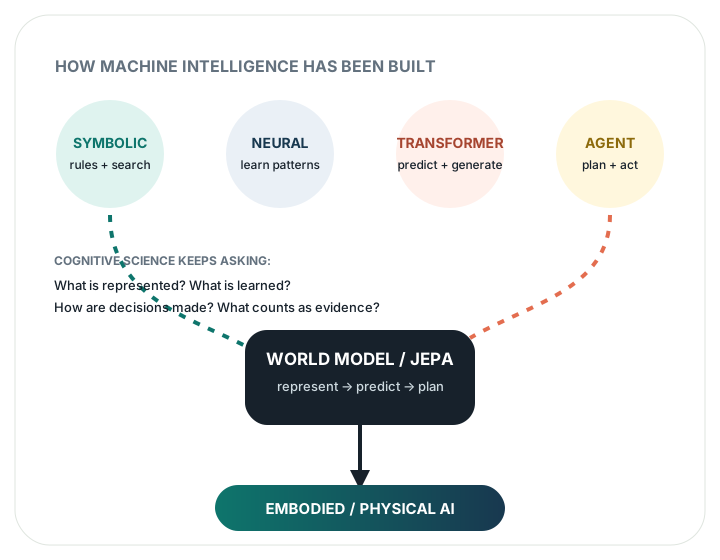
AI evolution concept map from symbolic AI to world models and embodied AI
YOUR DESTINATION

Three learning objectives

LO1 · APPLY

Concepts & ideas

Apply basic Cognitive Science concepts and ideas to explain major approaches and current developments in AI.

LO2 · INFER

Human ↔ machine

Infer similarities and differences between human cognition and machine intelligence through simple experiments and interactive activities.

LO3 · LEAD RESPONSIBLY

Ethics & problem solving

Demonstrate responsible application of AI by evaluating benefits, limitations, risks and ethical implications within your area of specialization.

BEFORE THE TECHNICAL PART

Why should I learn programming or technical AI?

You do not need to become a software engineer. You do need enough technical understanding to ask better questions, design better studies, recognize what AI can and cannot do, and work with technical specialists instead of treating AI as magic.
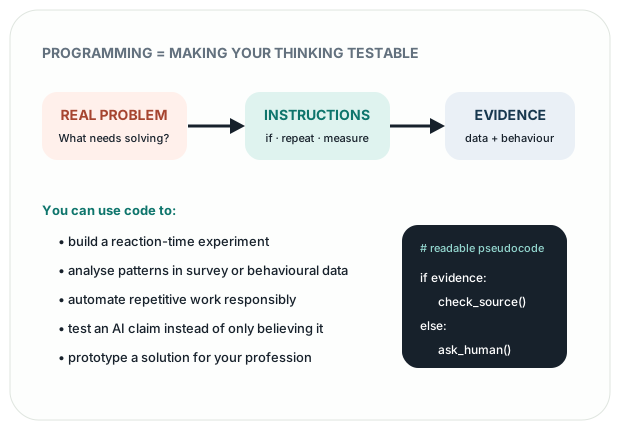
Programming as a bridge from a human problem to observable evidence and a solution
WEEK 1

How did AI learn to behave intelligently?

Foundations → learning → programming as structured problem solving.

4 h1 h with lecturer
3 h self-paced
Lecturer hour · suggested use Kick-off · “What counts as intelligence?” mini Turing activity · course navigation · explain how scores are recorded.
WEEK 2

Where is AI going now?

Agents → world models/JEPA → multimodal/embodied AI → responsible leadership.

4 h1 h with lecturer
3 h self-paced
Lecturer hour · suggested use Frontier AI update · debate “Does performance = understanding?” · compare discipline-specific use cases · ethical synthesis.
FROM YOUR LECTURER

My group learning materials

Sign in to see notes, readings, videos, concept maps, code examples, discussions and extra 10-point exercises published for your group.

Sign in to load materials assigned to your group.

RESEARCH SPOTLIGHT · AUGUST 2026

Can visual experience lead toward general intelligence?

arXiv 2608.25924

Visual General Intelligence: A White Paper

Kataoka and 20 co-authors ask whether intelligence grounded in images, video and geometry could provide another pathway toward general intelligence, rather than treating language as the only centre of AI development.

Important: this is a white paper proposing research directions and questions. It does not prove that visual intelligence has achieved AGI.

Open paper ↗

Connect it to Cognitive Science

  1. Perception: What can vision provide that text alone cannot?
  2. Representation: What should an intelligent system preserve from visual experience—pixels, objects, relations, events or possible actions?
  3. Learning: Does learning from video resemble anything about how humans learn from continuous experience?
  4. Embodiment: Is seeing enough, or does intelligence require acting in and receiving feedback from the world?
  5. Measurement: What benchmark would convince you that a system has broad visual intelligence rather than narrow recognition skill?
AI-audit prompt: Ask an AI to summarise the paper, then verify whether it correctly distinguishes the authors' proposed research agenda from established evidence. Mark each sentence: paper-supported, interpretation, or unsupported extension.
UPDATED 7 SEPTEMBER 2026

Frontier AI radar

Current examples are used as case studies—not as proof that any company has “solved intelligence.”

MY LEARNING RECORD

Scores & progress

Sign in as a student to save results across devices. Each activity is worth 10 points.

UPLOAD TO eLEAP

Visual self-evaluation

Compare your confidence before and after the SIM, then download the visual as a PNG for your eLEAP submission.

This is a metacognitive self-evaluation, not an auto-marked quiz. Your six scored activities remain A1–A6.

READ FURTHER

Core readings & source trail

Use these to verify claims. Current product announcements are separated from independent/research sources.

STUDENT ACCESS

Sign in